
REVIEW · KATHMANDU CITY TOURS & SIGHTSEEING
Historical Kathmandu
Spiritual Kathmandu can feel both grand and intimate. This private temple circuit lets you see some of Nepal’s most important Hindu sites in a single day, with real-life worship happening around the Bagmati River and in the Patan area. I especially liked the close-up riverfront mood at Pashupatinath and the mix of major temples plus a classic open-air Vishnu site at Budhanilkantha. One thing to plan for: entrance fees are not included for every stop, and the timing matters because some temples have limited visiting windows.
You start from Thamel at 9:45am, ride point-to-point in a private AC vehicle, and finish back at the meeting spot. The pace is built for sightseeing, not long museum-style wandering, so you get a lot of sacred space without feeling stuck on the road all day. If you want a smoother day, it helps to go in with a flexible attitude about timing, especially around Pashupatinath and the Patan Durbar Square area where you may need to pay separately.
In This Review
- Key highlights worth knowing
- Entering the Hindu core of Kathmandu Valley
- Price and what you really get for $160
- Getting started in Thamel: the 9:45am rhythm
- Stop 1: Pashupatinath Temple and the Bagmati River setting
- What to expect here
- A practical consideration
- Stop 2: Budhanilkantha’s reclining Vishnu pool
- Why this stop works in the itinerary
- Stop 3: Guhyeshwari Shaktipeeth beside Pashupatinath
- How to get more out of a 30-minute stop
- Stop 4: Doleshwor Mahadeva in Bhaktapur and the bull-head link
- Why the Bhaktapur location adds value
- Stop 5: Patan Durbar Square and Krishna Mandir by Siddhi Narsinha Malla
- What makes this temple stop feel different
- The private AC vehicle and driver: more than comfort
- Timing, tickets, and respect: how to make the day easier
- A practical checklist for you
- Who this tour suits best
- Should you book Historical Kathmandu?
- FAQ
- How long is the Historical Kathmandu tour?
- What time does the tour start, and where do I meet?
- Is hotel pickup and drop-off included?
- Is this tour private or shared?
- Are entrance fees included for all the temple stops?
- What does the price include?
- Is free cancellation available?
Key highlights worth knowing
- Door-to-door private transport from Thamel: Hotel pickup and drop means less hassle before you even start sightseeing.
- Pashupatinath visiting hours can tighten the schedule: It opens 5am to 12pm and reopens 4pm to 7pm.
- Budhanilkantha is a standout open-air Vishnu experience: Expect the reclining Vishnu statue in a pool setting.
- Several stops are free, but not all: Some entrances are listed as not included, so budget a bit.
- You get Kathmandu and the Bhaktapur side of the valley: Doleshwor Mahadeva is in Bhaktapur, adding a wider feel to the day.
Other one shot sweeps of the Valley

Entering the Hindu core of Kathmandu Valley
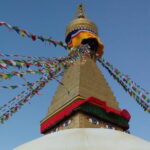
This tour is built around Hindu sacred sites, not just sightseeing photos. That matters in Kathmandu because the temples are not “dead monuments.” You’ll usually see worship, rituals, and everyday devotion shaping what the places feel like.
I like that the route doesn’t only repeat the biggest famous name. Yes, Pashupatinath is central, but the itinerary also includes Budhanilkantha’s open-air Vishnu pool scene, Guhyeshwari Shaktipeeth near Pashupatinath, and a Bhaktapur stop with a bull-head legend connection. By the time you reach Patan Durbar Square, the day has a good rhythm: Shiva, Vishnu, Shakti, and then more temple craftsmanship in Patan.
If you prefer a calm, respectful day of looking and learning at temples, you’ll probably enjoy this format. If you want a city tour with lots of markets and coffee stops, this is more temple-focused than city-exploring.
Price and what you really get for $160
At $160, the value comes from the package design: a private AC vehicle, hotel pickup and drop, mineral water, and fees and taxes for the tour itself. It’s not just transport, either. The vehicle is used on a point-to-point basis, so you’re not piecing together multiple rides.
What’s not included is equally important. Entrance fees for some sightseeing points are marked as not included, and lunch and snacks are not included. So think of the total cost as: the base price covers the private tour operation and transport, and you should set aside extra for temple tickets where needed.
For me, the best bargain angle is the door-to-door pickup combined with a private vehicle. Kathmandu’s traffic can be unpredictable, and starting in Thamel at a set time can save real energy.
Getting started in Thamel: the 9:45am rhythm
The tour starts in Thamel, Kathmandu 44600, with a 9:45am start time. The meeting point and start time are straightforward, and you end back at the meeting point, which helps if you want to keep your evening free.
You’ll have a mobile ticket, plus confirmation at booking time. That reduces the annoying scavenger-hunt feeling some tours create.
Because it’s private, only your group participates. That’s a big deal on temple days where you might want slower looking, a quick pause for photos, or just time to absorb what you’re seeing without waiting for other people’s pace.
You’ll also be near public transportation, so if anything changes in the city, you’ll likely still be able to get around. Just know this tour is designed around pickup, not public transit hopping.
Stop 1: Pashupatinath Temple and the Bagmati River setting
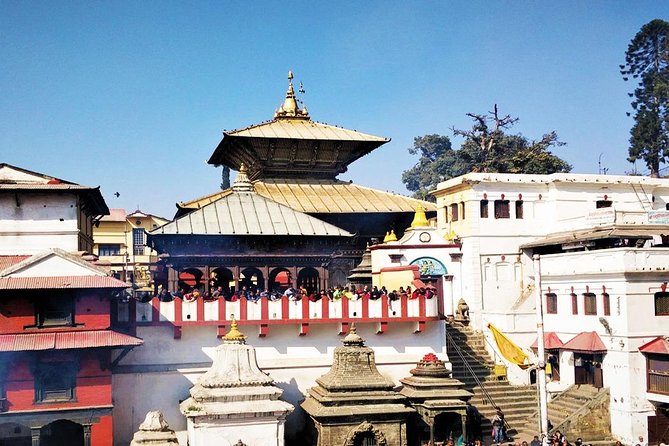
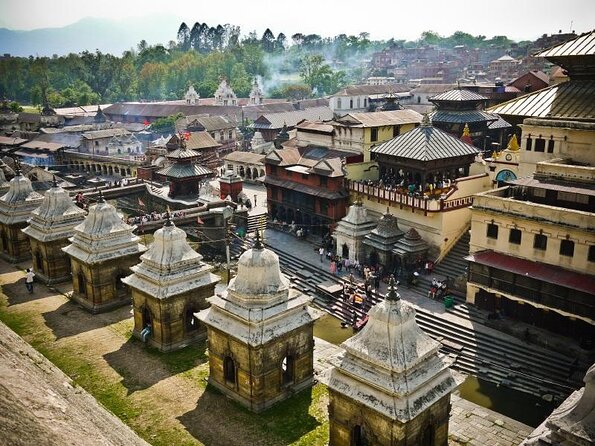
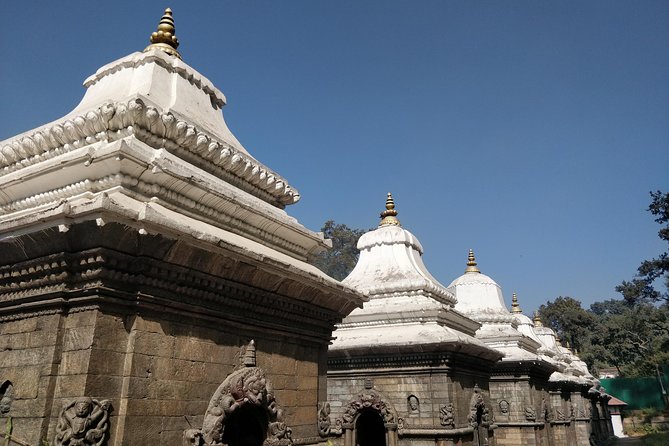
Pashupatinath is one of the biggest Shiva temples in the region, and the location hits you fast. It sits by the Bagmati River, with Bankali Forest around it. That combination creates a sensory mix of stone, water, ritual movement, and quiet stretches.
Plan around the hours. The main temple opens from 5:00am to 12:00pm, then reopens 4:00pm to 7:00pm. That means your day can feel tight if you arrive after the late morning window, and it also means you should be ready for a schedule that works with those limits.
The itinerary gives about 2 hours at this first major stop, which I like because it lets you do more than just a quick walk-by. Also, admission tickets for this stop are listed as not included, so be ready to pay separately if you decide you want to go in.
More old stones and living temples
What to expect here
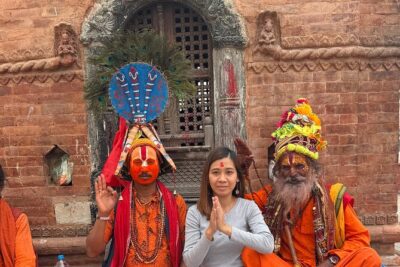
You’ll likely notice the temple’s role as a living spiritual center, not just an attraction. You’ll see worshipers moving with purpose and the riverfront setting that makes Pashupatinath feel physically connected to devotion.
A practical consideration
Temple hours and ticketing can influence your pacing more than you expect. If you’re the type who hates “time math,” come prepared to follow the tour plan.
Stop 2: Budhanilkantha’s reclining Vishnu pool
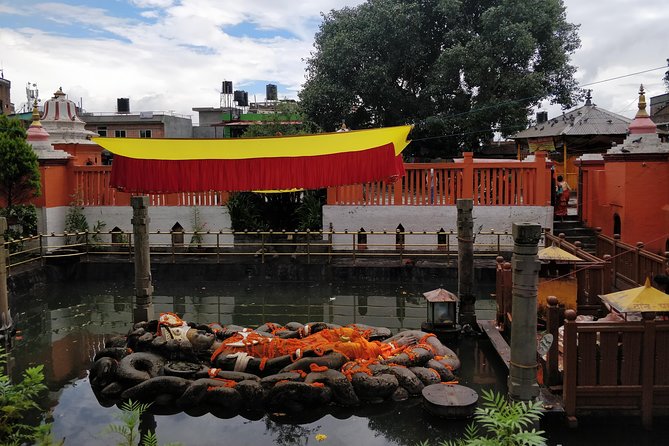
Next up is Budhanilkantha, a Hindu open-air temple for God Vishnu. It’s believed to be among the older temples of Kathmandu, and the centerpiece is unforgettable: a pool with a reclining statue of Vishnu.
This stop is described as Narayanthan, another name tied to Vishnu worship. I like that the tour gives you about 1 hour here, because it gives you time to look carefully at the water-and-statue composition without dragging the day too long.
The admission ticket is listed as free. That’s a nice break in the day when you want to focus on the visuals and the atmosphere rather than thinking about additional costs.
Why this stop works in the itinerary
After Pashupatinath (Shiva), Budhanilkantha shifts the mood to Vishnu in a very physical, open-air way. It also changes the setting, so you’re not just repeating stone-and-temple corridors.
Stop 3: Guhyeshwari Shaktipeeth beside Pashupatinath
Guhyeshwari is known as a Shaktipeeth dedicated to Goddess Parwati. The temple is situated just beside Pashupatinath, so the move between the two places feels natural and convenient.
This stop runs for about 30 minutes, and the admission is listed as free, so it’s a short spiritual boost rather than a full-blown long visit.
The story attached to this temple is part of why it stands out. It was built by Pratap Malla around the 17th century, and it’s believed to be the place where Sati’s hips or hind part fell.
How to get more out of a 30-minute stop
With only half an hour, you’ll benefit from simple priorities: look at what’s in front of you, read any available signs on-site, and stay aware of where worship activity is happening so you don’t accidentally block people.
This is one of those stops where the meaning matters as much as the physical space, even if you don’t spend long inside.
Stop 4: Doleshwor Mahadeva in Bhaktapur and the bull-head link
Doleshwor Mahadeva is located in Bhaktapur, which means your tour reaches beyond just central Kathmandu. The temple is tied to Lord Shiva devotees, and it comes with a specific legend connection to the Kedarnath pilgrimage.
Here’s the idea: Kedarnath is believed to have the body of a bull, while Doleshwor Mahadev is believed to have the head of a bull. Because of that, the Doleshwor visit is described as important enough that a Kedarnath trip is considered incomplete without it.
You’ll spend about 2 hours here, and the admission is listed as free. That combination makes it a good rest-of-the-day anchor, especially if you’re feeling your legs after earlier temple sections.
Why the Bhaktapur location adds value
Bhaktapur has a different feel from parts of Kathmandu. Even without a long wandering day there, including Doleshwor Mahadeva gives your temple route a broader valley sense.
Stop 5: Patan Durbar Square and Krishna Mandir by Siddhi Narsinha Malla
The final stop brings you to Patan Durbar Square and specifically the Krishna Mandir. This is where Hindu devotees and tourists come together to look around, and it’s also noted as one of the finer stone monuments.
The temple is said to have been built in 1637 A.D. by Siddhi Narsinha Malla. The stop is paired with about 2 hours of time, which is useful because Patan’s square area rewards slower browsing.
Admission for this stop is listed as not included, so factor in a possible ticket cost here as well.
What makes this temple stop feel different
By the time you reach Patan, the day has moved through Shiva, Vishnu, and Shakti. Krishna Mandir shifts the focus back into Vaishnav worship within a different architectural and street-setting.
If you like architecture details, stonework, and the way temple areas function as social space, you’ll likely enjoy taking your time before heading back.
The private AC vehicle and driver: more than comfort
This is not a bus tour. You get a private AC vehicle with a private driver, plus hotel pickup and drop. That means fewer logistics headaches, less waiting, and easier coordination when temple timing tightens.
The route is designed as point-to-point sightseeing, which is practical in Kathmandu where distance doesn’t always equal travel time.
Also, you receive a bottle of mineral water per person per day (1000 ml). It’s a small thing, but in a day that involves walking and heat, it keeps you from needing to scramble for basics.
From the experience notes associated with the operator, a smooth driver relationship has been a major highlight. One driver named Nethra was described as very helpful, and one customer credited planning support to Mr. Dipak, including airport welcome coordination. Those names matter mainly because they hint at what you should look for: clear communication and a driver who understands the rhythm of temple days.
Timing, tickets, and respect: how to make the day easier
Temple days go better when you think ahead in three categories: time, money, and behavior.
Time: Pashupatinath has a midday closure. If your day runs later than planned, you may need to adjust your expectations around what you can access during the opening window.
Money: Entrance tickets for some stops are not included, including Pashupatinath and Krishna Mandir in Patan Durbar Square.
Behavior: You’ll be walking through active religious spaces, so stay aware of worshipers and keep your movement respectful.
A practical checklist for you
- Wear comfortable shoes for uneven stone surfaces around temple areas.
- Bring a light layer, Kathmandu mornings and evenings can feel different than midday.
- Keep some cash ready in case you need to pay entrance fees on-site where not included.
Who this tour suits best
This tour is a great fit if you want a religion-and-architecture focused day with minimal city logistics stress. It also suits people who prefer private transport over group shuttles.
It’s especially good if you like Hindu sacred sites and want a route that covers Shiva, Vishnu, and Shakti in one day without hopping between random locations.
If you’re the type who expects long free time for shopping and city wandering, you might feel the temple schedule is more structured than you want. This is sightseeing with a plan, not a choose-your-own-adventure day.
Should you book Historical Kathmandu?
Book it if you want an efficient way to see major Hindu temples in Kathmandu Valley with hotel pickup, a private AC vehicle, and a time-managed route. At $160, the value is strongest when you want the comfort and coordination of a private operator and you’re okay paying entrance fees at the specific sites where tickets are not included.
Skip it or rethink if you strongly dislike schedule constraints. Pashupatinath hours can shape your day, and you’ll have less flexibility than you might in a loose self-guided temple walk.
My bottom line: if you want a focused, respectful temple day with practical transport and enough time at each key stop, this is a solid choice.
FAQ
How long is the Historical Kathmandu tour?
The duration is listed as approximately 1 to 7 hours.
What time does the tour start, and where do I meet?
It starts at 9:45am, and the meeting point is Thamel, Kathmandu 44600, Nepal.
Is hotel pickup and drop-off included?
Yes. Hotel pick up and drop are included.
Is this tour private or shared?
This is a private tour/activity. Only your group will participate.
Are entrance fees included for all the temple stops?
No. Entrance fees for sightseeing points are not included, though some stops are listed as having free admission.
What does the price include?
It includes a full day Kathmandu city historical tour, a private AC vehicle with a private driver, hotel pickup and drop, a bottle of mineral water per person per day (1000 ml), sightseeing vehicle on a point to point basis, and all fees and taxes.
Is free cancellation available?
Yes. You can cancel up to 24 hours in advance for a full refund.
Old Stones and Living Temples
The Rest of Our Kathmandu Write Ups


One More Valley Day
Everything else we have reviewed around Kathmandu
- 12 Days Everest Base Camp Trekking
★ 5.0 · 3 reviews - 1 Night 2 Days Chitwan Jungle Safari Tour from Pokhara or Kathmandu
★ 3.0 · 3 reviews - Thamel Rickshaw tour
★ 4.7 · 3 reviews - Kathmandu: Momo Making Class with a Local Chef
★ 5.0 · 3 reviews - Kathmandu: Full-Day Yoga, Body Massage and Pedicure Package
★ 5.0 · 3 reviews - From Kathmandu / Pokhara / Chitwan: River Rafting – 1 Day
★ 4.6 · 3 reviews
Kathmandu City Tours & Sightseeing worth a second look.
 ★ 5.0Kathmandu Private Sightseeing Tour | UNESCO World Heritage SitesFrom $35109 reviews
 ★ 5.0Private tour of Major highlights of Kathmandu top rated placesFrom $4492 reviews
 ★ 5.0Kathmandu Heritage Tour (Full Day)From $3863 reviews
 ★ 5.0Kathmandu Full Day TourFrom $7054 reviews
 ★ 5.0Life and spirituality tour of KathmanduFrom $5554 reviews
 ★ 5.0Kathmandu Highlights: Private UNESCO World Heritage Sites TourFrom $4950 reviews
 ★ 5.0Full Day Private Tour of Kathmandu – UNESCO World Heritage SitesFrom $3542 reviews
 ★ 5.0Kathmandu Valley City Day TourFrom $6040 reviews
Lists this tour sits in