
REVIEW · KATHMANDU UNESCO HERITAGE TOURS
UNESCO Seven World Heritage Tour in Kathmandu
Kathmandu in one nonstop day can sound wild. This tour strings together all seven UNESCO World Heritage sites in the Kathmandu Valley with a private guide and private vehicle, so you spend less time stuck in transit and more time understanding what you are looking at.
What I like most is the English-speaking guide who explains the Hindu and Buddhist meaning behind the temples and monuments, and the fact that the tour includes the required entry fees at the seven heritage stops. The main drawback to plan for is simple: it is a long day, and you will do plenty of steps and walking, including major stair climbs like at Swayambhunath.
In This Review
- Key highlights before you go
- Price and logistics: what you actually get for $180
- The rhythm of a 12-hour UNESCO day in Kathmandu
- Stop 1: Swayambhunath (Monkey Temple) and the view that anchors the day
- Amideva Buddha Park: a short ride, a big change in mood
- Kathmandu Durbar Square and Kumari Chowk: palaces, devotion, and reconstruction
- Durbar Square highlights: Krishna Temple and stone artistry
- Stop 4 to 6: Patan Durbar Square, the Golden Temple zone, and the Patan Museum stop
- Bhaktapur Durbar Square: one of the best places to feel old Kathmandu
- Changu Narayan: the hilltop UNESCO stop that feels different
- Pashupatinath: sacred scale and a complex temple world
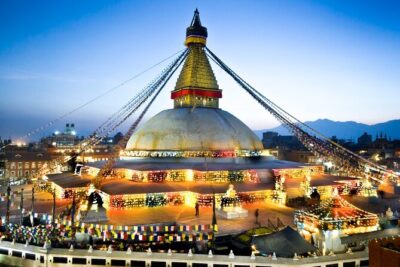
- Boudhanath Stupa: one of the biggest mandalas you will see
- Guides and drivers: the difference between seeing and understanding
- Best fit: who this UNESCO day tour is for
- Should you book this UNESCO Seven World Heritage Tour in Kathmandu?
- FAQ
- How long is the UNESCO Seven World Heritage Tour in Kathmandu?
- What is included in the $180 per person price?
- Is lunch included?
- What should I wear for the tour?
- Are entry tickets included for all UNESCO stops?
- Do you provide pickup and drop-off?
- What is the cancellation policy?
Key highlights before you go
- All seven UNESCO sites in one day, with a plan built for tight schedules
- Private vehicle plus an on-hand guide, so you are not guessing what you are seeing
- Entry tickets included at the seven heritage sites, so your costs stay predictable
- Bhaktapur coverage that goes beyond the main square, with extra temple stops inside the heritage zone
- Changu Narayan on a hilltop, one of the oldest temple visits on the itinerary
- Guides that flex to your pace, including time for photos and slower exploring when you want it
Other seven site heritage runs
Price and logistics: what you actually get for $180
At $180 per person, this tour is priced like a full day of real sightseeing support, not like a budget bus hop. The big value is that you get a private car, an English-speaking guide, hotel pickup and drop-off, and entry fees included for the seven UNESCO heritage sites. Lunch is not included, so you will still have to make one food decision, but you are free to choose what fits your day and energy.
The tour is about 12 hours in length, and it is typically planned as a day that starts early and runs until evening. One of the most helpful details from the booking data is that it is often reserved about 37 days in advance, which is a good hint that popular guides and pickup times get chosen quickly.
Dress code is listed as smart casual, and you will be doing a lot of walking. Bring sun protection and wear comfortable shoes, because even “short” stops can involve steps, uneven stone, or climbing to viewpoints.
The rhythm of a 12-hour UNESCO day in Kathmandu
This is the kind of day where the itinerary is ambitious, but the pacing can still feel human if your guide manages timing well. The tour uses a private car to save time between far-flung sites, and that matters in Kathmandu. Without that, you would lose a big chunk of the day just moving between the UNESCO areas.
Most of the time blocks are set for quick, focused visits, but the best part is that guides in this program tend to adapt. In real customer feedback, guides like Shanti, Pankaj, and Kabita are repeatedly described as friendly, organized, and willing to adjust timing for interests, photos, or extra time in specific spots.
The tradeoff is that you are still covering a lot of ground. Think of this tour as a fast, guided overview that helps you decide what deserves a deeper return trip later.
Stop 1: Swayambhunath (Monkey Temple) and the view that anchors the day
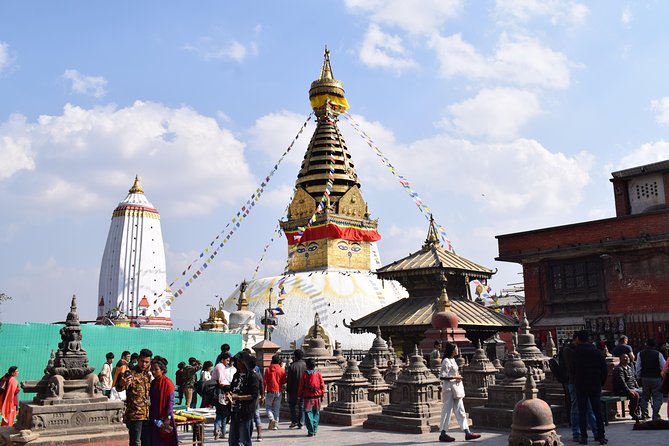
Swayambhunath is your first big wow moment, and it makes sense as a starting point. You are going up to a hilltop stupa area known as the Monkey Temple, and the approach itself sets the tone: prayer wheels, small shrines, and a mix of Hindu and Buddhist symbolism living side by side.
A key practical detail: you will deal with stairs. The tour notes 365 stairs to reach the top, and the payoff is that classic Kathmandu skyline view. If you are planning photo time, this is where you want to slow down, because the visibility from the stupa area is one of the strongest visual anchors of the day.
You also get time to walk around the stupa and interact with prayer-wheel traditions. Entry is included at this stop, so you can focus on orientation and not on ticket logistics.
Amideva Buddha Park: a short ride, a big change in mood
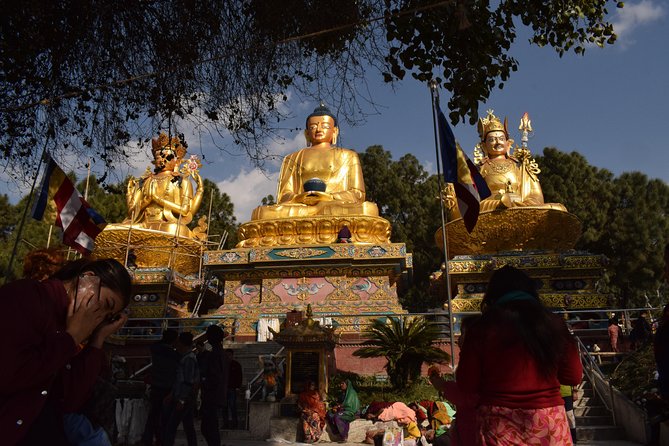
Right after Swayambhunath, you go to Amideva Buddha Park for a much more spaced-out feeling. The tour description highlights three large Buddha statues that usually grab attention fast.
This stop is brief, about 10 minutes, which makes it a good breather between the stair-heavy hilltop and the palace squares in town. It is also a nice reminder that the Kathmandu Valley is not just about one faith. This day intentionally moves between Hindu and Buddhist sacred spaces.
More old stones and living temples
Kathmandu Durbar Square and Kumari Chowk: palaces, devotion, and reconstruction
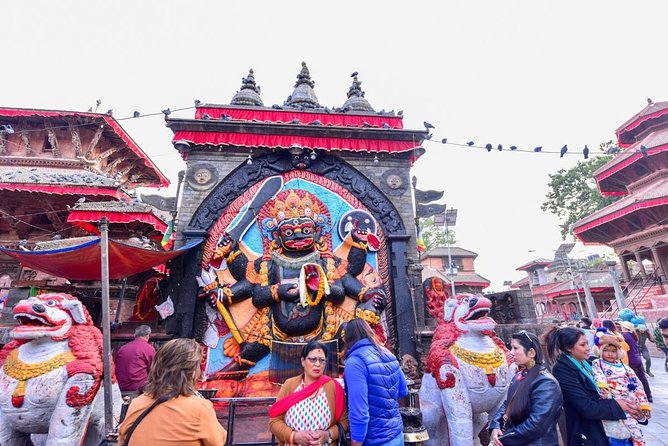
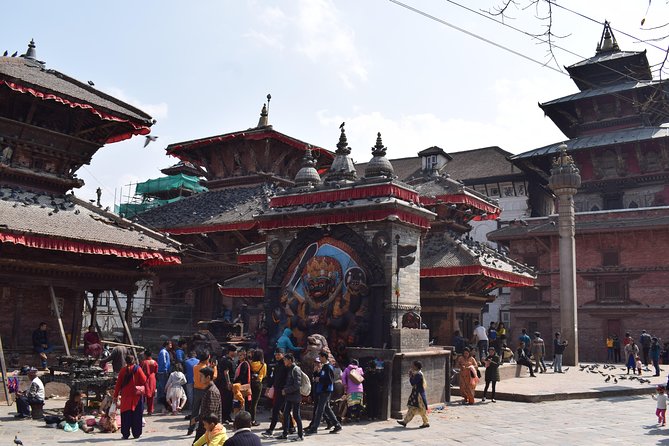
Next you reach central Kathmandu’s heritage core: Kathmandu Durbar Square and Kumari Chowk. Durbar Square is where you see layers of old power, religious practice, and the reality of a living city that changes over time.
Kumari Chowk is focused on the sacred courtyard linked to the living goddess tradition. The tour describes it as a red-brick, three-level building and explains how the Kumari is selected and then becomes a mere mortal after puberty. Even if you do not know the story already, your guide should connect it to the larger Kathmandu religious calendar.
One consideration here: Durbar Square areas can involve construction or visible restoration in places. The tour description notes that some parts are under reconstruction while there are still many explorable sites around the square. That is not a dealbreaker, it is just part of what you should expect when you visit heritage sites that are actively maintained.
Durbar Square highlights: Krishna Temple and stone artistry
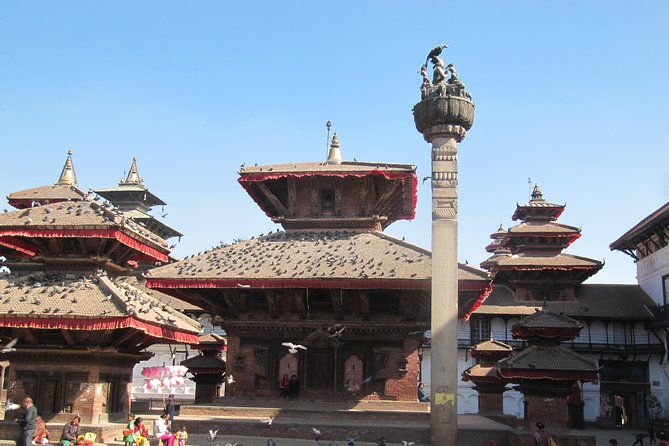
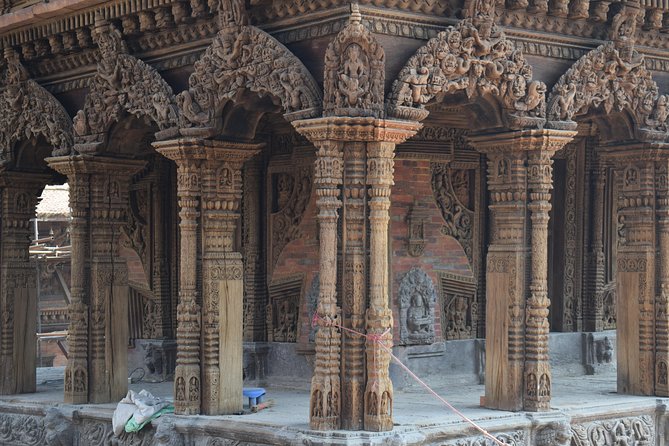
Within the Durbar Square time, you also visit key temple features such as the stone-built Krishna Temple, highlighted for its stone-only construction and the presence of multiple shrines nearby. This is the kind of detail your guide can make satisfying, because the carvings and layout can feel overwhelming if you are only seeing from the surface.
This segment is about 25 minutes at the Durbar Square stop. If you are the type who likes to read inscriptions or trace motifs, ask your guide to slow down for ten minutes. The best guide in this program will know how to balance “enough seeing” with “not rushing you.”
Entry tickets are included at these heritage stops, so you keep moving without constant interruptions.
Stop 4 to 6: Patan Durbar Square, the Golden Temple zone, and the Patan Museum stop
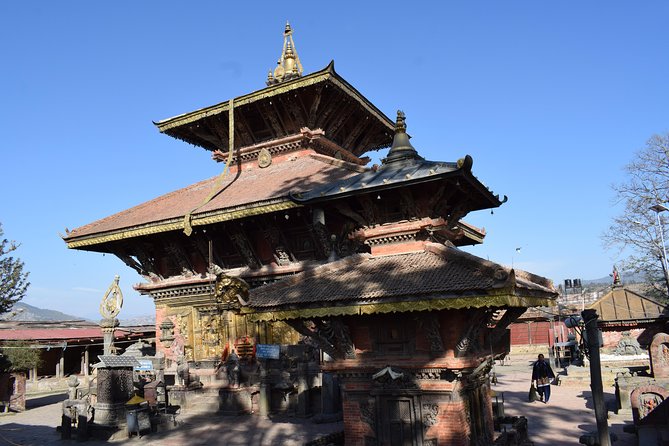
After Kathmandu’s core, you move into Patan, also known as Lalitpur. Patan Durbar Square is described as the courtyard of the old Malla palace, filled with Newari architecture and community life. If you like architectural textures, this is a strong part of the day because Patan tends to feel visually dense in a way that rewards attention.
The tour includes Patan Durbar Square and then adds a broader sweep that includes the Golden Temple (Hiranya Varna Mahavihar) time. The description points out its pagoda-style form and mentions bronze statues plus silver and gold ornamentation, which helps you understand why the site is often called golden.
There is also a stop around Keshav Narayan Chowk tied to the Patan Museum. The tour description says you can look at facts about tradition and history, and specifically mentions historic Japanese civilization. That gives you a clue that the museum stop is not just a generic break, it is meant as context while you are already surrounded by heritage.
Timing matters here. These Patan sections are not long, so if museums are your priority, keep your expectations realistic: you are sampling, not doing a deep archive day.
Bhaktapur Durbar Square: one of the best places to feel old Kathmandu
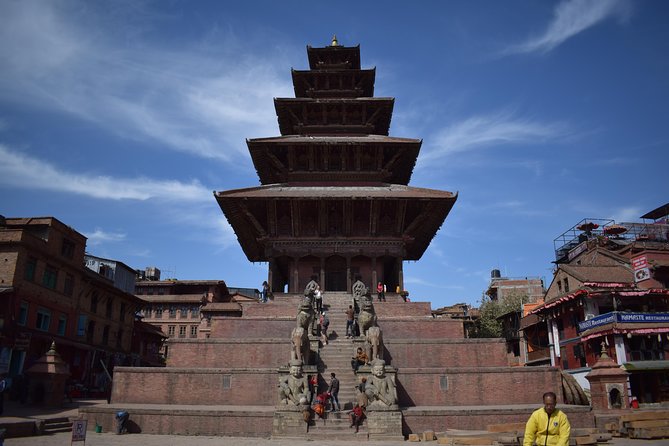
Bhaktapur is often where this itinerary becomes more than a checklist. The tour highlights well-preserved Bhaktapur and calls it the City of Devotees, with many old-style houses and buildings intact. Bhaktapur Durbar Square itself is the UNESCO heritage anchor, but the tour adds multiple “inside the zone” sights.
The itinerary lists additional Bhaktapur temple stops including:
- Nyatapola Temple, a five-leveled pagoda-style structure that the description notes as among the tallest pagodas
- Dattatreya Temple on Dattatreya Square, described as being believed built from a single tree stem
- 55 Window Palace, a durbar-square structure named for its carved windows
- Siddha Pokhari, a long manmade pond near the city gate
These additions are smart if your goal is to understand the culture, not only the main plaza. Bhaktapur rewards slow looking, but you still need to keep your energy up because this is another day-long moving segment.
Lunch in Bhaktapur is not included. The good news is that you can choose where to eat based on your taste and schedule. I would treat this as your chance to reset, because the later hilltop temple and the larger stupa and temple complexes will require a calmer mind.
Changu Narayan: the hilltop UNESCO stop that feels different
One of the most valuable parts of this tour is that it includes Changu Narayan Temple. The description emphasizes that it dates back to the Licchavi period and is made of stone and wood carvings.
This is your hilltop, and the experience tends to land differently than the flatter palace squares. You are seeing something older and more isolated in feel. The stop is listed as around 1 hour, which is a good length for a site where you may want to compare carvings, take a minute to orient yourself, and let your guide explain what you are seeing.
Entry fees are included here, so the time is all about the experience itself.
Pashupatinath: sacred scale and a complex temple world
Next comes Pashupatinath Temple, described as one of Nepal’s largest temple complexes, housing more than 500 temples and shrines in the area. It is an enormous sacred zone, and that scale can hit you quickly.
The tour description also notes the complex covers 0.64 hectares, and even that number helps you visualize that you are not stepping into a single building. This is a whole spiritual district.
The stop is listed at about 1 hour. That is long enough to walk, pause, and understand the rules of the place through your guide’s explanation. If you are sensitive to crowds or intense religious activity, tell your guide early. A flexible guide will help you time pauses and keep you comfortable.
Entry tickets are included at this heritage stop, which again reduces friction during a very full day.
Boudhanath Stupa: one of the biggest mandalas you will see
The day closes with Boudhanath Stupa, one of the major Buddhist pilgrimage sites. The tour description calls it a major mandala, 36 meters tall, with over 50 gompas built around it.
This stop is also about 1 hour, and it is a great way to end because it feels rhythmic. You can spend time looking at the stupa’s shape, watching prayer activity, and letting your guide connect what you are seeing to broader Buddhist practice. It is a strong “wrap your head around it” finale after the complexity of temple courtyards earlier in the day.
Admission is included, so your last hour stays focused on the sacred space rather than tickets and lines.
Guides and drivers: the difference between seeing and understanding
A lot of day tours in Kathmandu succeed or fail on guidance. Here, the pattern in feedback is very consistent: guides like Shanti, Pankaj, Kabita, Som, and Sarita are described as friendly, organized, and able to answer questions about Hinduism and Buddhism and the temple history.
What I take from that, as you plan your own day, is that you should treat the guide as part teacher, part traffic coordinator, part pace-setter. In multiple reviews, guides are praised for not rushing people and adjusting timing to personal interests. Some even helped with practical details like minimizing unwanted street vendor interruptions and helping with photo timing.
Drivers are also repeatedly mentioned for safety in chaotic traffic, and that matters when your day includes multiple far-apart sites. A good driver keeps the day from turning into a stress test.
One practical note from feedback worth remembering: wear walking shoes and plan for stairs. The tour is described as long and walk-heavy, even when it uses a private car between sights.
Best fit: who this UNESCO day tour is for
This tour makes the most sense if:
- You have limited time in Kathmandu Valley and want the fastest reliable overview of all seven UNESCO sites
- You prefer a private car and guided explanations over self-guided wandering
- You want entry fees handled so you can focus on learning and photos
- You like heritage that mixes art, religion, and local life, from durbar squares to stupa complexes
It might be less ideal if:
- You hate long days or you struggle with stairs and walking
- You want unhurried, museum-depth time at every stop
- You need frequent downtime between closely timed heritage zones
Should you book this UNESCO Seven World Heritage Tour in Kathmandu?
Yes, if your top goal is efficient, guided coverage of the Kathmandu Valley UNESCO sites. For the $180 price, you are buying more than sightseeing, you are buying the friction-free parts: hotel pickup and drop-off, private transport, an English guide, and included admissions at the seven key sites.
Book it sooner rather than later, since demand seems steady and this is often reserved weeks ahead. If you do book, commit to the basics that make the day work: comfortable shoes, water, sun protection, and a mindset of seeing a lot first, then returning later to go deeper.
If you are on the fence, here is my simple decision rule. If you want a once-in-a-lifetime guided overview, do it. If you already know you will be revisiting Kathmandu Valley multiple times, you could consider picking only one or two areas. For most first-timers with limited time, this one-day plan is a smart way to build your bearings.
FAQ
How long is the UNESCO Seven World Heritage Tour in Kathmandu?
The tour is listed at about 12 hours.
What is included in the $180 per person price?
The price includes a private vehicle, an English speaking guide, all required entry fees in the 7 heritage sites, and hotel pickup and drop off.
Is lunch included?
No. Lunch in Bhaktapur is not included, and you are free to choose from many eateries there.
What should I wear for the tour?
The dress code is smart casual.
Are entry tickets included for all UNESCO stops?
Yes. All required entry fee in the 7 heritage sites are included.
Do you provide pickup and drop-off?
Yes. The tour includes hotel pick up and drop off.
What is the cancellation policy?
There is free cancellation. You can cancel up to 24 hours in advance for a full refund.
Everything Bookable Around Kathmandu
The Rest of Our Kathmandu Write Ups

Seven Sites, Other Routes
Everything else we have reviewed around Kathmandu
- 12 Days Everest Base Camp Trekking
★ 5.0 · 3 reviews - 1 Night 2 Days Chitwan Jungle Safari Tour from Pokhara or Kathmandu
★ 3.0 · 3 reviews - Thamel Rickshaw tour
★ 4.7 · 3 reviews - Kathmandu: Momo Making Class with a Local Chef
★ 5.0 · 3 reviews - Kathmandu: Full-Day Yoga, Body Massage and Pedicure Package
★ 5.0 · 3 reviews - From Kathmandu / Pokhara / Chitwan: River Rafting – 1 Day
★ 4.6 · 3 reviews
Kathmandu UNESCO Heritage Tours worth a second look.
 ★ 5.0Full Day 7 UNESCO Tour with Lunch – Private/GroupFrom $10415 reviews
 ★ 5.0Full Day Top 4 UNESCO Tour with Lunch – Private/GroupFrom $10269 reviews
★ 4.9Full-Day 7 UNESCO Tour with Lunch – Private/GroupFrom $5247 reviews
★ 5.0Full Day Top 4 UNESCO Tour with Lunch – Private/GroupFrom $10269 reviews
★ 4.9Full-Day 7 UNESCO Tour with Lunch – Private/GroupFrom $5247 reviews
 ★ 4.97 UNESCO Sites Tour in 1 Day (Private Tour)From $4204 reviews
 ★ 4.9Top 4 UNESCO Tour with Lunch – Private/GroupFrom $5181 reviews
 ★ 5.0Bhaktapur & Patan Durbar Square Day ToursFrom $50122 reviews
 ★ 5.0Kathmandu Private Sightseeing Tour | UNESCO World Heritage SitesFrom $35109 reviews
★ 5.0Full Day 7 UNESCO Tour with Lunch – Private/GroupFrom $5101 reviews
★ 5.0Kathmandu Private Sightseeing Tour | UNESCO World Heritage SitesFrom $35109 reviews
★ 5.0Full Day 7 UNESCO Tour with Lunch – Private/GroupFrom $5101 reviews
Lists this tour sits in